


 Notification



 Guide
Guide


This article explains how to create realistic software simulations using Adobe Captivate. You will learn how to record your screen, use different simulation modes, and enhance slides with shapes, instructions, and interactive elements. By the end, you will understand how to build engaging simulations that help learners safely practice using software.
Have you ever wished you could teach someone how to use software without sitting beside them the whole time? Adobe Captivate makes this possible. It lets you record your actions on screen and turn them into a fully interactive learning experience. Whether you want to show someone how to browse a website, fill a form, or navigate a complex tool, Captivate has you covered.
By the end, you’ll understand how to build a software simulation, add visual shapes and interactive elements to make it look polished, and deliver a course that feels realistic and engaging.
What Is a Software Simulation?
A software simulation is like a recorded walkthrough of a software application. Adobe Captivate watches what you do on screen – your mouse clicks, keyboard inputs, and navigation – and converts all of it into an interactive eLearning course.
The learner then views this course and can either watch what you did, practice it themselves, or be tested on it. It’s a safe, controlled way for people to learn software without touching the real application.
The Three Simulation Modes
Before you start recording, you need to decide what kind of simulation you want to create. Captivate offers three modes, and you can actually record all three at the same time.
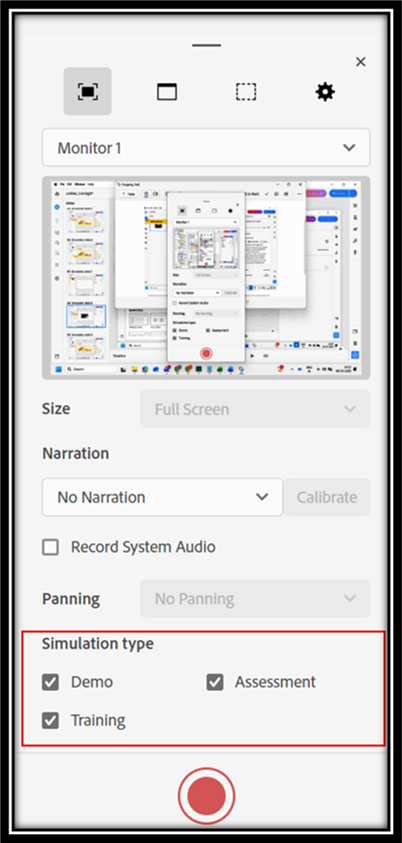
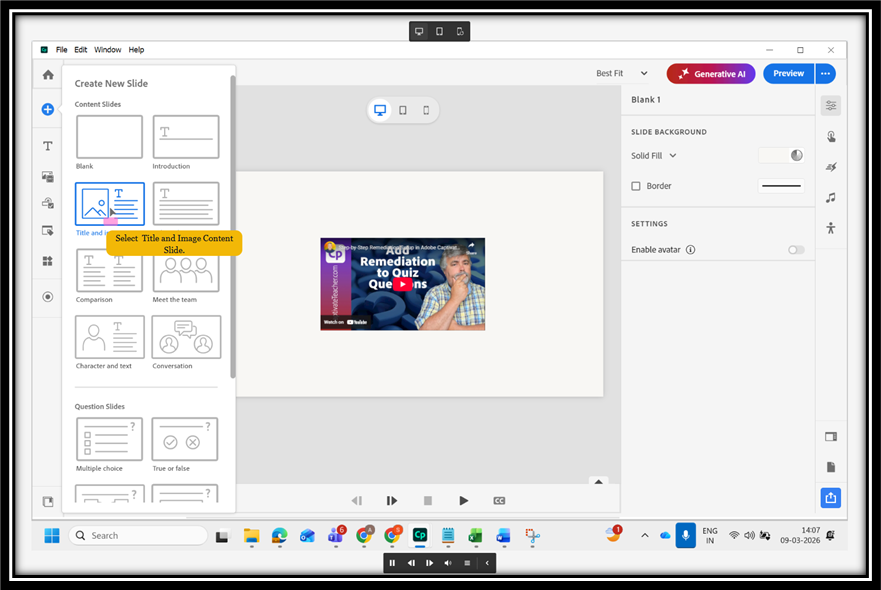
Demo Mode is for showing. The learner watches you complete a task without having to do anything themselves. Captivate automatically adds text captions that describe each action as it happens. This is great for quick introductions or when you simply want someone to see how something works.
Training Mode is for practicing. Here, the learner must interact with the simulation. They have to click the right areas, and if they get it wrong, a helpful message appears telling them to try again. A hint also pops up if they hover near the correct spot. This mode builds confidence before learners move to the real application.
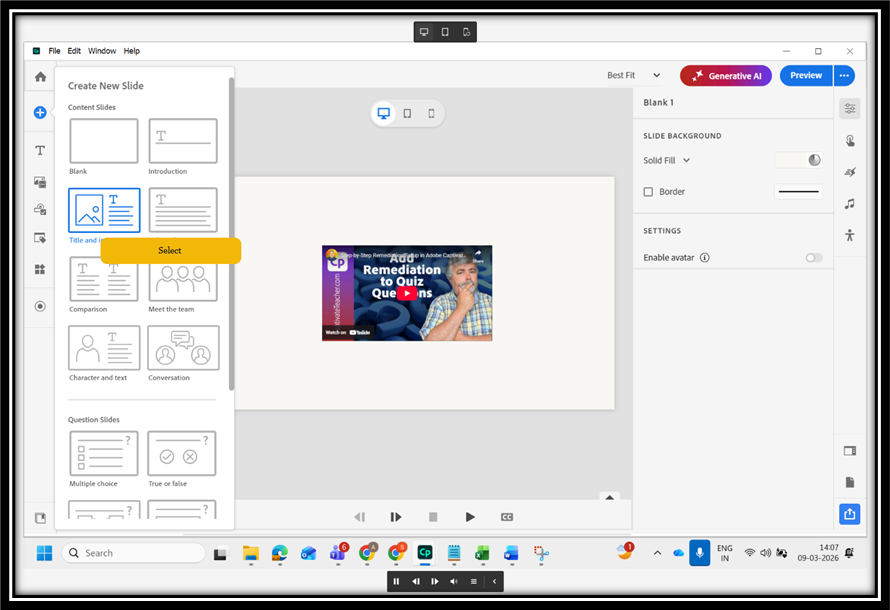
Assessment Mode is for testing. It works like Training Mode but without hints. Test the user’s knowledge of a procedure. Only inform the user if the step was incorrectly carried out.
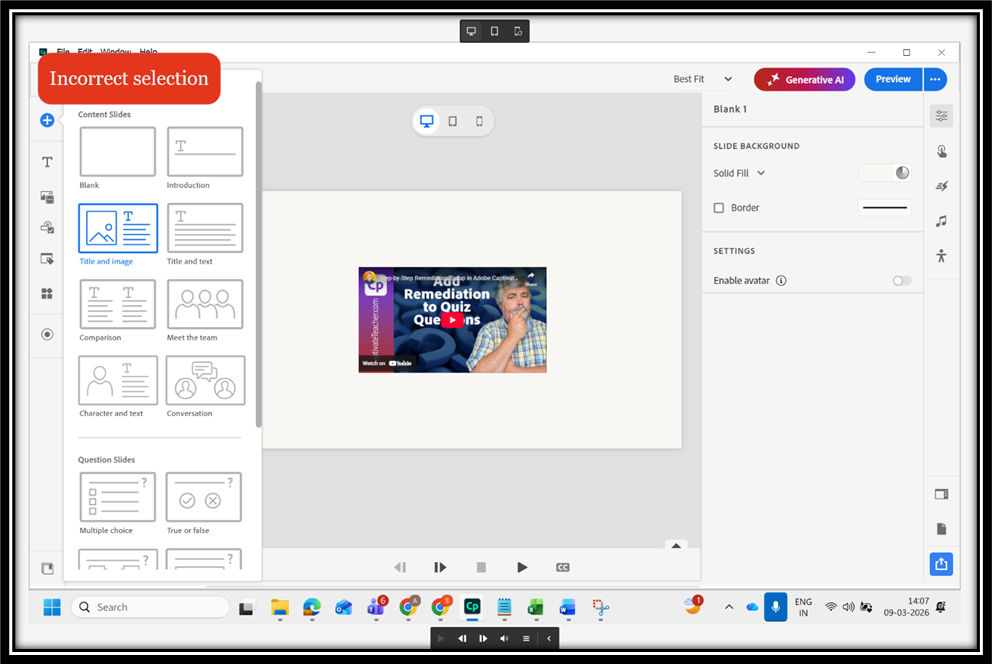
Setting Up Your Simulation
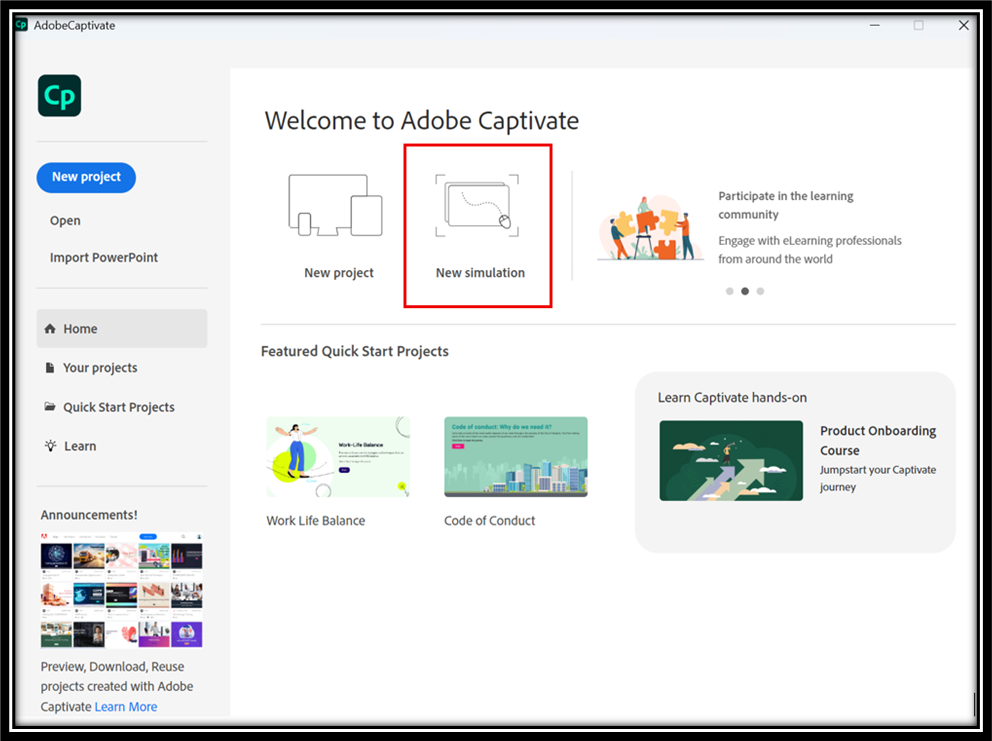
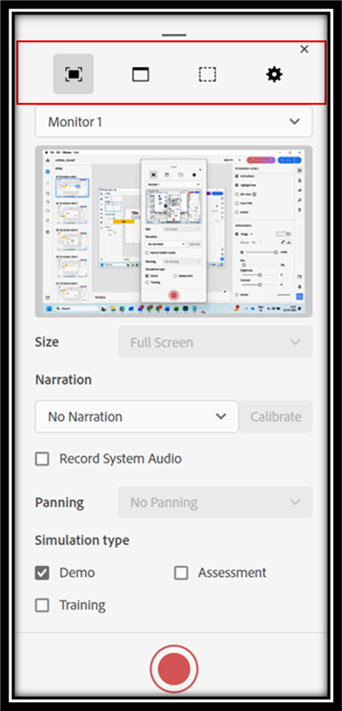
To begin, open Adobe Captivate and click New Simulation on the welcome screen. A launcher dialog will appear where you choose how you want to record your screen.
You have three options for the recording window. Fullscreen Capture records your entire monitor – useful if your workflow spans the whole screen. If you have two monitors, you can pick which one to use. Application Window narrows the recording to one specific open application, keeping things focused. Custom Size lets you define your own width and height if you need something specific.
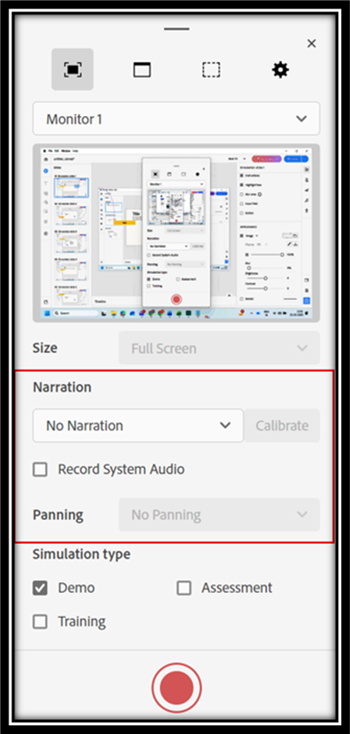
Once you choose your window type, you can also set up narration by selecting a microphone, and turn on panning if your screen is large. Panning lets the recording window follow your mouse so nothing gets cut off. You can set it to move automatically or manually.
The Recording Pod
When recording begins, a small toolbar called the Recording Pod appears in the bottom-right corner of your screen. You can drag it anywhere – it won’t affect your recording.
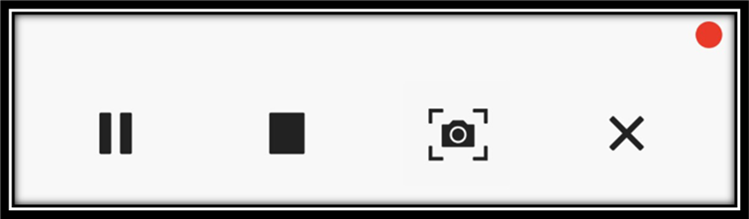
A blinking red dot on the pod tells you recording is active. The pod gives you four controls. Play/Pause lets you temporarily stop and resume recording. Stop ends the session – you can also press Cmd + Return on a Mac or the End key on Windows. Capture Screenshot takes a manual snapshot at any point and adds it as a slide to your project. Cancel ends the recording without saving anything.
Enhancing Slides with Shapes and Components
Once your recording is done, Captivate creates a series of slides one for each key action you performed. These slides look like screenshots of the software you recorded. But here’s where it gets interesting: you can add visual shapes and interactive elements to each slide to make the simulation richer and more realistic.
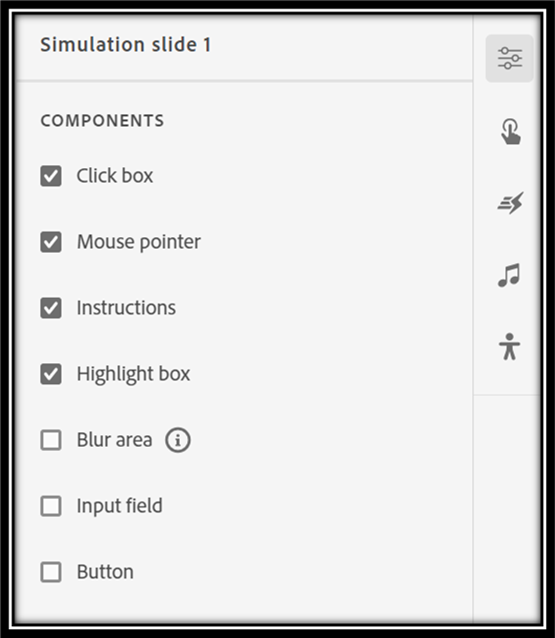
In the Visual Properties panel, under the Components section, you’ll find several elements you can place on any slide.
- Click Boxes
A click box is an invisible area on a slide that the learner must click to move to the next step. Think of it as a hotspot. You can place it over a button, menu, or any area of the screen. In Training and Assessment modes, click boxes are created automatically based on where you clicked during recording. You can also add or adjust them manually.
- Mouse Pointer
The mouse pointer shows the path the cursor takes between actions. By default, Captivate draws a gentle curved path, which looks natural and human. But you can switch to a straight path if that better matches your workflow – for example, when clicking quickly across a toolbar.
You can also change the pointer’s visual appearance, make it larger or smaller, add a click animation (a quick burst of color that highlights where the learner clicked), and change or mute the click sound.
- Instructions
Instructions are text boxes that appear on the slide to guide the learner. You can add up to three instruction blocks per slide. They’re great for telling learners exactly what to do next. Once you select an instruction, you can customize it fully – change the background color, add a border, adjust the shadow, and control the opacity so it blends nicely with the slide. You can even drag it to a different position on screen.
- Highlight Boxes
A highlight box is a colored rectangle that draws the learner’s attention to a specific part of the slide. It’s automatically added around areas you clicked during recording. You can keep it, remove it, resize it, change its color, add a gradient fill, or apply a shadow. Adjusting the opacity makes it more or less visible depending on how subtle you want it to be.
- Blur Area
If your screen recording captured any sensitive information – like a personal email, a password, or a phone number – the blur area tool is your best friend. You add a blur shape over that region, and it hides the information from the learner.
You can control how strong the blur is using an intensity slider. The shape can be a rectangle or a circle. You can also adjust the corner radius to soften the edges and add a border around it. All of these controls are found in the Visual Properties panel after selecting the blur component.
- Input Fields
An input field lets learners type a response directly into the simulation slide. This is useful when you want to simulate filling out a form or entering a search query.
- Button
Buttons are clickable elements you can add to simulation slides. They can take learners to the next slide, trigger a specific action, or navigate to another part of the course. They improve interactivity and give learners more control over their experience. You can add multiple buttons to a single slide.
All these settings are in the Visual Properties panel under Appearance and Settings. Once you’re happy, click Apply to all slides to update every slide in your project at once.
Changing the Background Appearance
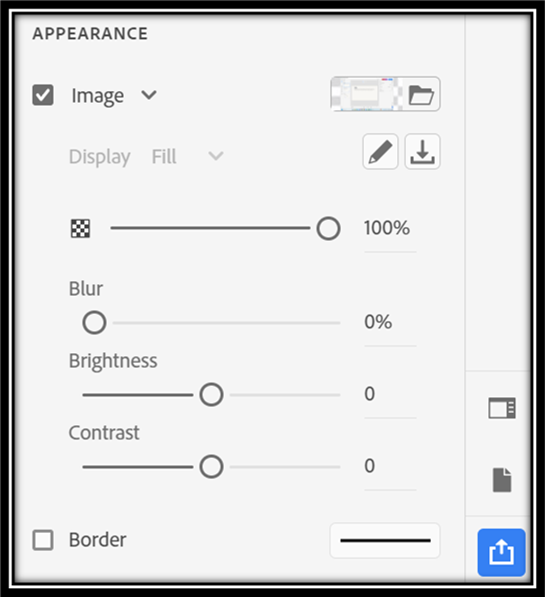
Beyond shapes and components, you can also change how the slide background looks. In the Appearance section, select the Image dropdown to apply a solid color fill or gradient to the background. Or choose an actual image from your computer or Captivate’s built-in asset library. You can crop the background image, add a border around it, or download it.
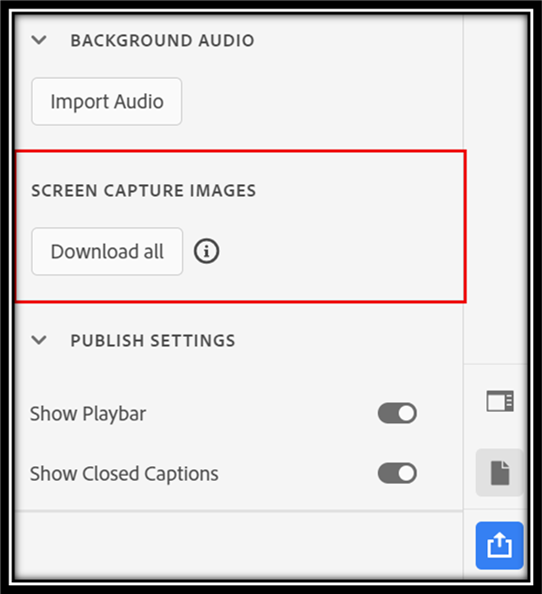
If you want to save all the background images from your project at once, go to Project Properties in the right toolbar and click Download all images – Captivate will save them all to a folder on your computer.
Full-Motion Recording for Smooth Actions
Some actions are hard to capture with still screenshots. Dragging and dropping, scrolling through a list, or hovering over a menu might not look right as a series of static slides. That’s where Full-Motion Recording (FMR) helps.
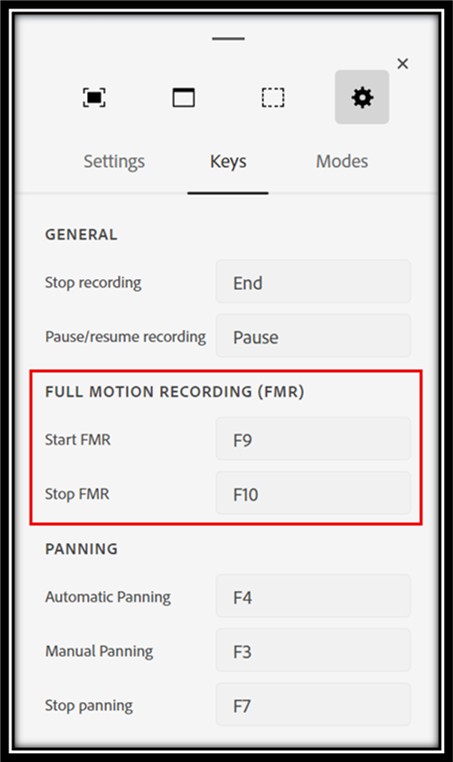
FMR records everything as a continuous video clip instead of individual screenshots. It activates automatically if your mouse moves outside the recording boundary. You can also turn it on and off manually using keyboard shortcuts – Fn + F9 to start and Fn + F10 to stop on Windows, or Cmd + F9 and Cmd + F10 on macOS.
FMR slides appear in the timeline as videos. You can still add components like click boxes and instructions to these video slides, just like regular simulation slides. The main difference is that FMR slides play as videos, while regular simulation slides are static images.
Adding a Simulation to an Existing Project
You don’t have to create a new project every time you want to add a simulation. If you already have a Captivate course, you can record a new simulation directly into it.
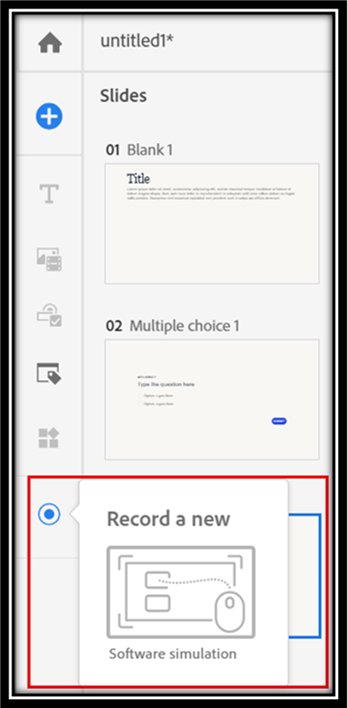
Open your existing project, click Capture in the left toolbar, and choose Software Simulation. The recording launcher will appear. Pick your simulation type, press Record, and when you’re done, the new simulation slides are added right into your existing project.
One small thing to note: if your recording is smaller than 1366 × 768 pixels, Captivate fits it inside a standard-size slide. If it’s larger, the slide grows to match the recording size.
Conclusion
Adobe Captivate makes it surprisingly straightforward to build software simulations that look and feel professional. The combination of recording modes, visual components like highlight boxes and blur areas, customizable instructions, and mouse pointer settings gives you everything you need to create an experience that genuinely mirrors using real software.
Start with a simple demo, get comfortable with the tools, and then explore Training and Assessment modes to take your courses to the next level. Once you see how much learners benefit from being able to practice in a safe environment, you’ll never go back to plain screenshots or written instructions alone.
Have you ever wished you could teach someone how to use software without sitting beside them the whole time? Adobe Captivate makes this possible. It lets you record your actions on screen and turn them into a fully interactive learning experience. Whether you want to show someone how to browse a website, fill a form, or navigate a complex tool, Captivate has you covered.
By the end, you’ll understand how to build a software simulation, add visual shapes and interactive elements to make it look polished, and deliver a course that feels realistic and engaging.
What Is a Software Simulation?
A software simulation is like a recorded walkthrough of a software application. Adobe Captivate watches what you do on screen – your mouse clicks, keyboard inputs, and navigation – and converts all of it into an interactive eLearning course.
The learner then views this course and can either watch what you did, practice it themselves, or be tested on it. It’s a safe, controlled way for people to learn software without touching the real application.
The Three Simulation Modes
Before you start recording, you need to decide what kind of simulation you want to create. Captivate offers three modes, and you can actually record all three at the same time.
Demo Mode is for showing. The learner watches you complete a task without having to do anything themselves. Captivate automatically adds text captions that describe each action as it happens. This is great for quick introductions or when you simply want someone to see how something works.
Training Mode is for practicing. Here, the learner must interact with the simulation. They have to click the right areas, and if they get it wrong, a helpful message appears telling them to try again. A hint also pops up if they hover near the correct spot. This mode builds confidence before learners move to the real application.
Assessment Mode is for testing. It works like Training Mode but without hints. Test the user’s knowledge of a procedure. Only inform the user if the step was incorrectly carried out.
Setting Up Your Simulation
To begin, open Adobe Captivate and click New Simulation on the welcome screen. A launcher dialog will appear where you choose how you want to record your screen.
You have three options for the recording window. Fullscreen Capture records your entire monitor – useful if your workflow spans the whole screen. If you have two monitors, you can pick which one to use. Application Window narrows the recording to one specific open application, keeping things focused. Custom Size lets you define your own width and height if you need something specific.
Once you choose your window type, you can also set up narration by selecting a microphone, and turn on panning if your screen is large. Panning lets the recording window follow your mouse so nothing gets cut off. You can set it to move automatically or manually.
The Recording Pod
When recording begins, a small toolbar called the Recording Pod appears in the bottom-right corner of your screen. You can drag it anywhere – it won’t affect your recording.
A blinking red dot on the pod tells you recording is active. The pod gives you four controls. Play/Pause lets you temporarily stop and resume recording. Stop ends the session – you can also press Cmd + Return on a Mac or the End key on Windows. Capture Screenshot takes a manual snapshot at any point and adds it as a slide to your project. Cancel ends the recording without saving anything.
Enhancing Slides with Shapes and Components
Once your recording is done, Captivate creates a series of slides one for each key action you performed. These slides look like screenshots of the software you recorded. But here’s where it gets interesting: you can add visual shapes and interactive elements to each slide to make the simulation richer and more realistic.
In the Visual Properties panel, under the Components section, you’ll find several elements you can place on any slide.
- Click Boxes
A click box is an invisible area on a slide that the learner must click to move to the next step. Think of it as a hotspot. You can place it over a button, menu, or any area of the screen. In Training and Assessment modes, click boxes are created automatically based on where you clicked during recording. You can also add or adjust them manually.
- Mouse Pointer
The mouse pointer shows the path the cursor takes between actions. By default, Captivate draws a gentle curved path, which looks natural and human. But you can switch to a straight path if that better matches your workflow – for example, when clicking quickly across a toolbar.
You can also change the pointer’s visual appearance, make it larger or smaller, add a click animation (a quick burst of color that highlights where the learner clicked), and change or mute the click sound.
- Instructions
Instructions are text boxes that appear on the slide to guide the learner. You can add up to three instruction blocks per slide. They’re great for telling learners exactly what to do next. Once you select an instruction, you can customize it fully – change the background color, add a border, adjust the shadow, and control the opacity so it blends nicely with the slide. You can even drag it to a different position on screen.
- Highlight Boxes
A highlight box is a colored rectangle that draws the learner’s attention to a specific part of the slide. It’s automatically added around areas you clicked during recording. You can keep it, remove it, resize it, change its color, add a gradient fill, or apply a shadow. Adjusting the opacity makes it more or less visible depending on how subtle you want it to be.
- Blur Area
If your screen recording captured any sensitive information – like a personal email, a password, or a phone number – the blur area tool is your best friend. You add a blur shape over that region, and it hides the information from the learner.
You can control how strong the blur is using an intensity slider. The shape can be a rectangle or a circle. You can also adjust the corner radius to soften the edges and add a border around it. All of these controls are found in the Visual Properties panel after selecting the blur component.
- Input Fields
An input field lets learners type a response directly into the simulation slide. This is useful when you want to simulate filling out a form or entering a search query.
- Button
Buttons are clickable elements you can add to simulation slides. They can take learners to the next slide, trigger a specific action, or navigate to another part of the course. They improve interactivity and give learners more control over their experience. You can add multiple buttons to a single slide.
All these settings are in the Visual Properties panel under Appearance and Settings. Once you’re happy, click Apply to all slides to update every slide in your project at once.
Changing the Background Appearance
Beyond shapes and components, you can also change how the slide background looks. In the Appearance section, select the Image dropdown to apply a solid color fill or gradient to the background. Or choose an actual image from your computer or Captivate’s built-in asset library. You can crop the background image, add a border around it, or download it.
If you want to save all the background images from your project at once, go to Project Properties in the right toolbar and click Download all images – Captivate will save them all to a folder on your computer.
Full-Motion Recording for Smooth Actions
Some actions are hard to capture with still screenshots. Dragging and dropping, scrolling through a list, or hovering over a menu might not look right as a series of static slides. That’s where Full-Motion Recording (FMR) helps.
FMR records everything as a continuous video clip instead of individual screenshots. It activates automatically if your mouse moves outside the recording boundary. You can also turn it on and off manually using keyboard shortcuts – Fn + F9 to start and Fn + F10 to stop on Windows, or Cmd + F9 and Cmd + F10 on macOS.
FMR slides appear in the timeline as videos. You can still add components like click boxes and instructions to these video slides, just like regular simulation slides. The main difference is that FMR slides play as videos, while regular simulation slides are static images.
Adding a Simulation to an Existing Project
You don’t have to create a new project every time you want to add a simulation. If you already have a Captivate course, you can record a new simulation directly into it.
Open your existing project, click Capture in the left toolbar, and choose Software Simulation. The recording launcher will appear. Pick your simulation type, press Record, and when you’re done, the new simulation slides are added right into your existing project.
One small thing to note: if your recording is smaller than 1366 × 768 pixels, Captivate fits it inside a standard-size slide. If it’s larger, the slide grows to match the recording size.
Conclusion
Adobe Captivate makes it surprisingly straightforward to build software simulations that look and feel professional. The combination of recording modes, visual components like highlight boxes and blur areas, customizable instructions, and mouse pointer settings gives you everything you need to create an experience that genuinely mirrors using real software.
Start with a simple demo, get comfortable with the tools, and then explore Training and Assessment modes to take your courses to the next level. Once you see how much learners benefit from being able to practice in a safe environment, you’ll never go back to plain screenshots or written instructions alone.
You must be logged in to post a comment.

- Most Recent
- Most Relevant


