


 Notification



 Wizard


This article explains how Artificial Intelligence is improving technical training across industries like manufacturing, healthcare, finance, and IT. It shows that AI helps create faster, more interactive, and updated learning programs while human experts ensure accuracy and quality. The focus is on combining AI efficiency with human oversight to build smarter, safer, and more effective training.
Technical training plays a critical role in modern organizations. It helps employees move beyond theoretical knowledge and apply skills in real work situations. Whether someone is operating machinery in a factory, managing financial systems, working in a laboratory, or writing software code, technical training ensures they can perform tasks safely and correctly.
Traditional technical training often relied on long presentations, manuals, and static courses. While these methods provided information, they did not always help learners practice real-world decision-making. In industries where mistakes can lead to safety risks, financial loss, or system failure, training must go further than simply delivering information.
Today, Artificial Intelligence (AI) is helping organizations improve how technical training programs are designed and delivered. AI does not replace instructional designers or subject matter experts. Instead, it helps speed up course creation, generate learning scenarios, and support scalable digital learning programs.
Across industries such as manufacturing, healthcare, finance, and IT, AI is becoming a powerful tool that helps training teams build better learning experiences faster.
This article explains how AI is improving technical training programs and why human oversight remains essential to ensure accuracy, quality, and effectiveness.
Understanding Technical Training in Modern Organizations
Technical training focuses on teaching employees how to perform specialized tasks within their roles. These tasks may include operating equipment, following safety procedures, using complex software systems, or maintaining critical infrastructure.
Unlike general learning programs, technical training requires practical understanding. Employees must be able to apply what they learn in real situations.
For example:
- Factory workers must operate machines safely and identify equipment problems.
- Healthcare professionals must follow precise lab procedures and use medical equipment correctly.
- Financial analysts must navigate complex systems that monitor transactions.
- Software engineers must understand coding frameworks and cloud platforms.
In large organizations with multiple locations, keeping this training accurate and updated is challenging. Processes change, tools evolve, and regulations are frequently updated. Training teams must constantly revise learning materials.
This is where AI tools can make a significant difference.
AI helps training teams create and update learning content faster while maintaining consistency across large organizations.
Where AI Fits in Technical Training Development
AI works best as a support tool during the course development process. It helps generate first drafts of training content that instructional designers can refine.

Instead of starting from scratch, training teams can use AI to:
- Generate course outlines
- Convert documents into learning modules
- Create assessments and scenario-based exercises
- Draft scripts for training videos
- Produce visual job aids and diagrams
However, AI-generated content must always be reviewed by instructional designers and subject matter experts. Technical training often involves safety procedures, compliance rules, or system instructions. These details must be accurate.
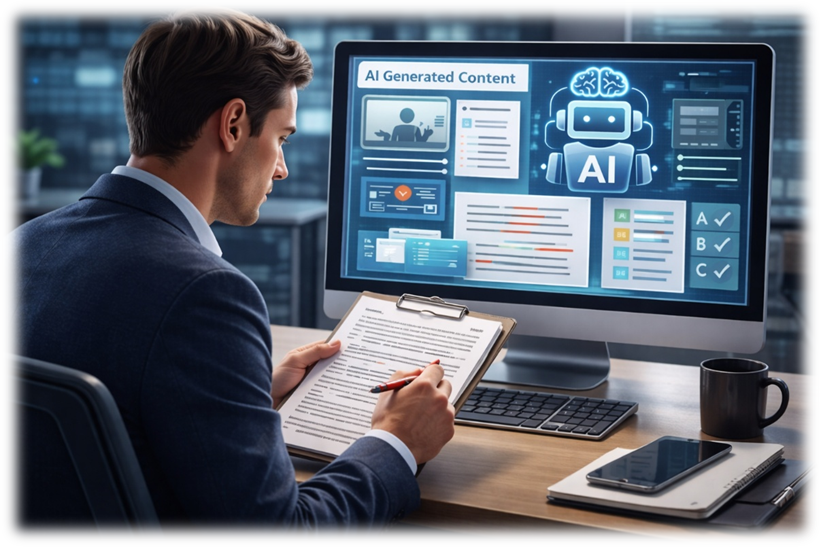
Because of this, the most effective approach is AI-assisted training development with human validation.
AI speeds up content creation, while experts ensure that the information is correct and aligned with organizational standards.
AI in Manufacturing Technical Training
Manufacturing organizations rely heavily on technical training. Workers must understand how to operate equipment, perform maintenance tasks, and follow safety procedures.
Training often includes instructions for troubleshooting machines, identifying faults, and responding to emergencies.
AI is helping manufacturing companies improve training programs in several ways.
Safety Scenario Generation
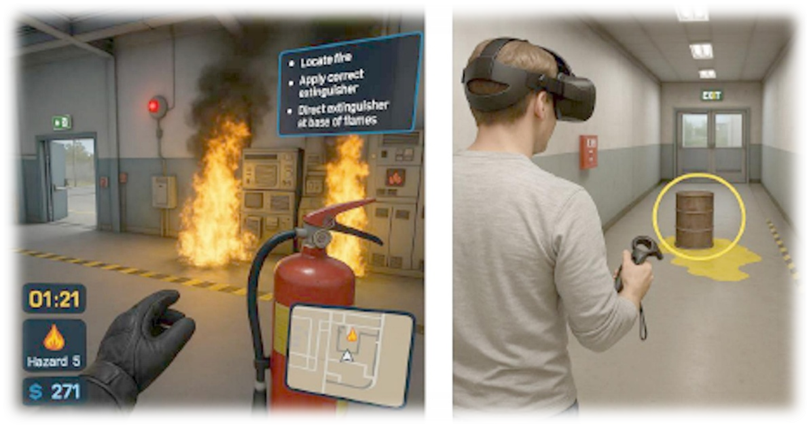
AI can generate realistic workplace scenarios based on common safety incidents. These scenarios allow employees to practice decision-making before entering real work environments.
Instead of reading safety rules in slides, learners can interact with simulated situations and choose how to respond.
Visual Job Aid Creation
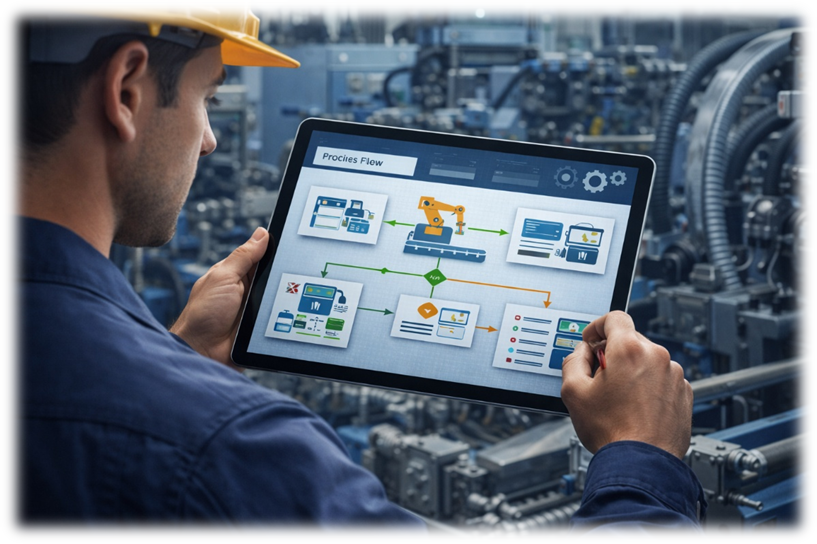
Manufacturing tasks often involve complex processes. AI tools can help create visual guides such as:
- Process maps
- Annotated diagrams
- Step-by-step instructions
These visual materials make it easier for workers to understand procedures.
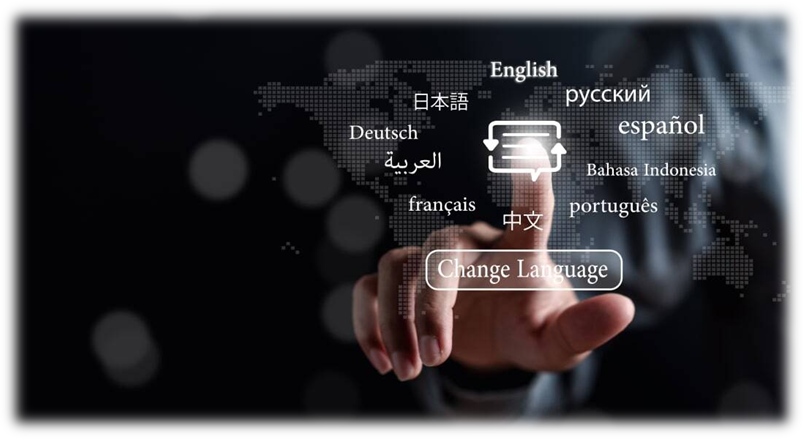
Multilingual Learning Modules
Large manufacturing companies often operate across different countries. AI-powered translation tools help training teams create learning modules in multiple languages quickly.
This ensures that workers across locations receive consistent training.
What Problems Does This Solve?
AI helps reduce several challenges in manufacturing training:
- Slow updates when equipment changes
- Difficulty scaling training across multiple plants
- Overuse of text-heavy training slides
With AI support, training teams can update learning materials faster while keeping workers informed and prepared.
AI in Pharma and Healthcare Training
Technical training in healthcare and pharmaceutical organizations must meet strict regulatory standards. Employees must follow precise procedures when handling equipment, running tests, or managing clinical systems.
Training programs must also be updated regularly to match new regulations and inspection requirements.
AI is helping training teams develop more practical and scalable learning programs.
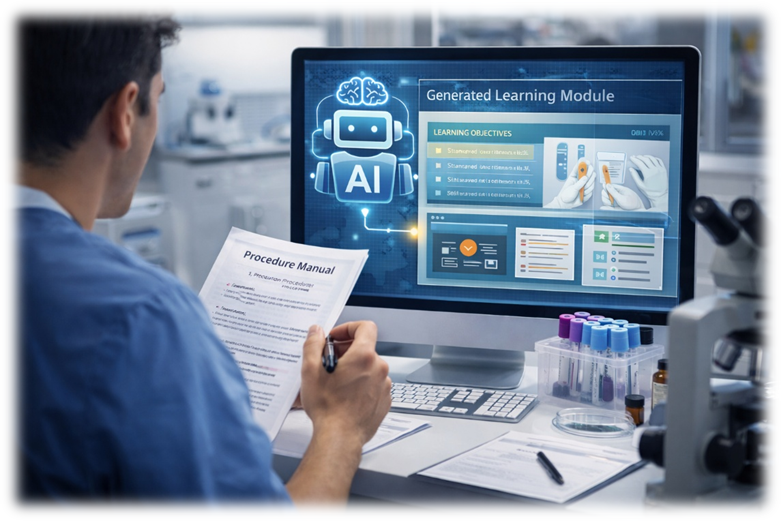
Converting Procedures into Learning Modules
Many healthcare processes are documented in detailed procedure manuals. AI tools can analyze these documents and convert them into structured learning modules.
This includes generating:
- Learning objectives
- Step-by-step training instructions
- Knowledge checks and assessments
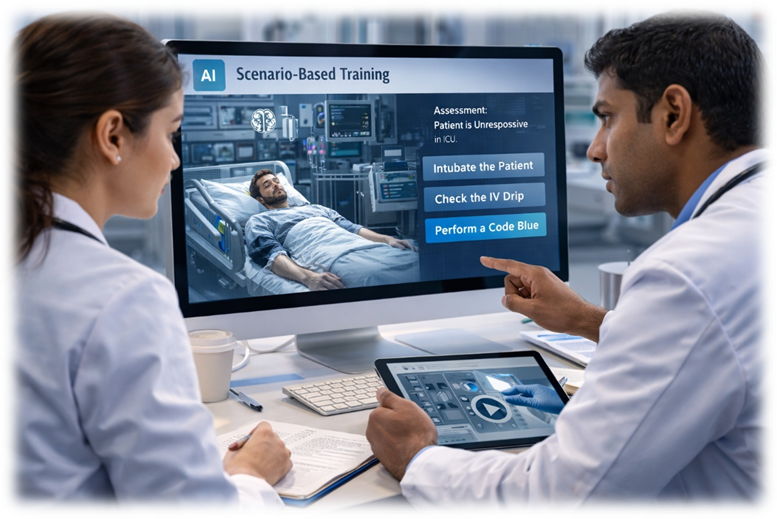
Scenario-Based Learning
Healthcare professionals must make decisions in complex environments. AI can generate realistic scenarios that simulate hospital or laboratory situations.
These scenarios help learners practice applying procedures instead of only reading instructions.
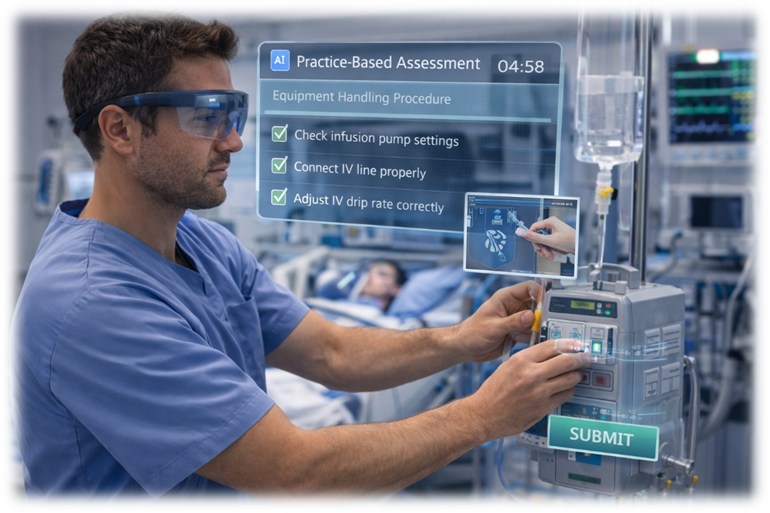
Practice-Based Assessments
AI can help design assessments that test real-world skills, such as:
- Equipment handling procedures
- Laboratory workflow steps
- Clinical system operations
These assessments help learners build confidence before performing tasks in real environments.
What Problems Does This Solve?
AI-supported training helps healthcare organizations address common challenges:
- Delays in updating training materials
- Inconsistent training across hospitals or labs
- Overuse of theory-heavy learning content
By enabling faster course development, AI helps training teams maintain high standards while supporting large teams.
AI in Finance, Fintech, and BFSI Training
Financial institutions in the Banking, Financial Services, and Insurance (BFSI) sector rely on complex systems to manage transactions, monitor risks, and investigate suspicious activity. Employees must understand how to use these systems accurately and efficiently.
Technical training in finance and BFSI focuses on system workflows and operational procedures.
AI tools are helping training teams build more flexible learning programs.
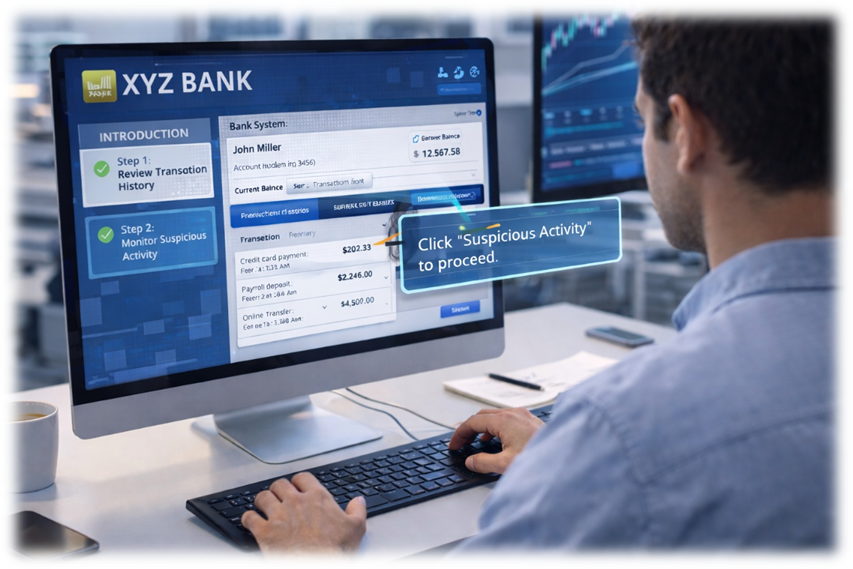
System Simulation Development
AI can help create scripts for system walkthroughs and interactive simulations. These simulations show learners how to navigate digital platforms step by step.
Instead of reading instructions, learners can explore simulated systems and practice tasks.
Role-Based Learning
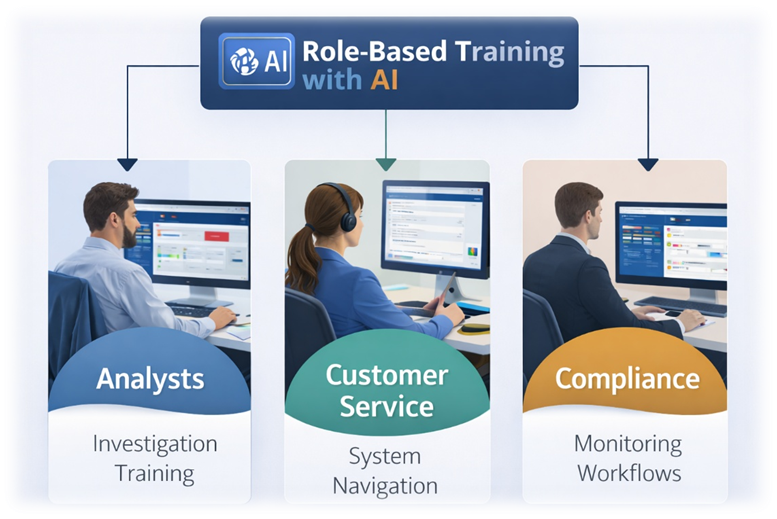
Employees in finance, fintech, and BFSI organizations perform highly specialized roles, with compliance and regulatory requirements playing a critical role. AI can help adapt training content for different roles without requiring a complete course redesign.
For example:
- Compliance teams may need training on regulatory requirements, AML processes, KYC verification, and fraud monitoring workflows
- Risk management teams may require training on risk assessment systems and reporting procedures
- Operations teams may need training on transaction processing, exception handling, and reconciliation workflows
- Customer-facing teams may require training on secure data handling and customer verification procedures
AI can help tailor training modules for these different needs while maintaining role-specific learning paths.
However, the BFSI sector operates under strict regulatory and data privacy requirements. Due to the confidential nature of financial data, organizations often implement guardrails when using AI. Leaders may be cautious about AI adoption because of concerns around data security, compliance, and regulatory risks.
As a result, AI in BFSI training is typically used within secure environments, controlled data inputs, and with human oversight to ensure compliance, accuracy, and confidentiality.
What Problems Does This Solve?
AI reduces several bottlenecks in financial training programs:
- Repetitive learning modules across departments
- Slow development of new training scenarios
- Complex content updates when systems change
With AI support, training teams can develop role-specific learning experiences more efficiently.
AI in IT and Software Training
The technology industry evolves rapidly. New tools, frameworks, and platforms appear constantly. Because of this, technical training programs must be updated frequently.
AI is particularly useful in IT training environments where practical exercises are essential.
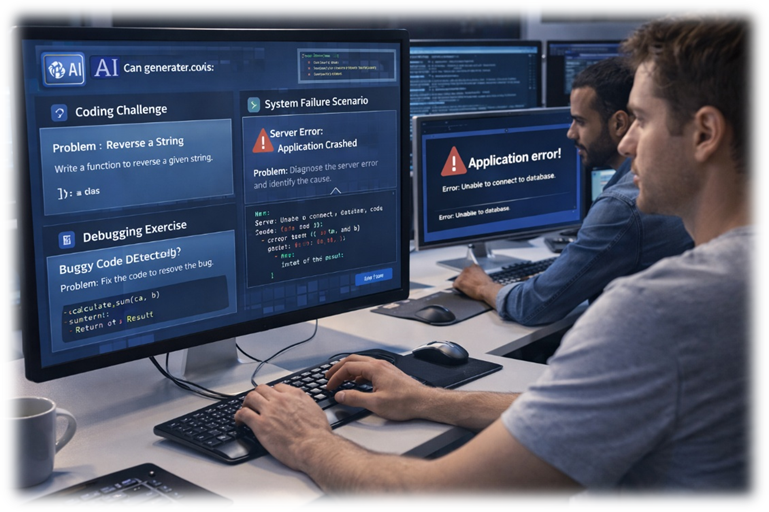
Coding Challenges and Technical Scenarios
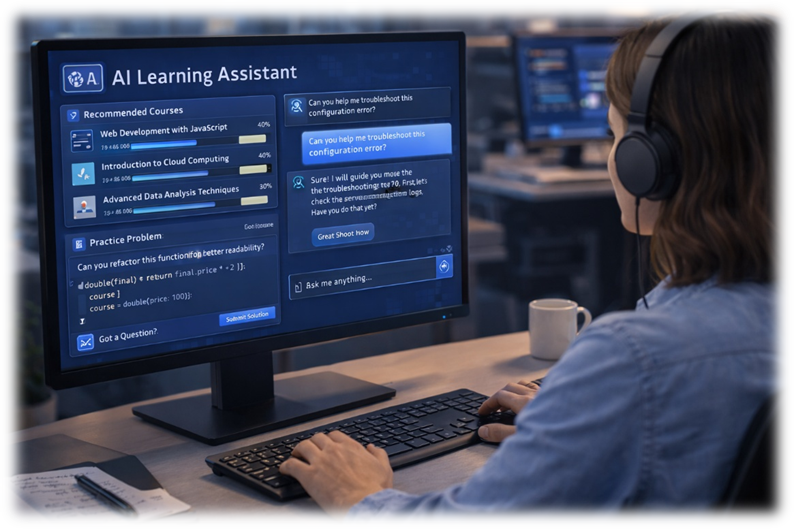
AI can generate coding problems, debugging exercises, and system failure scenarios. These activities help developers practice solving real technical issues.
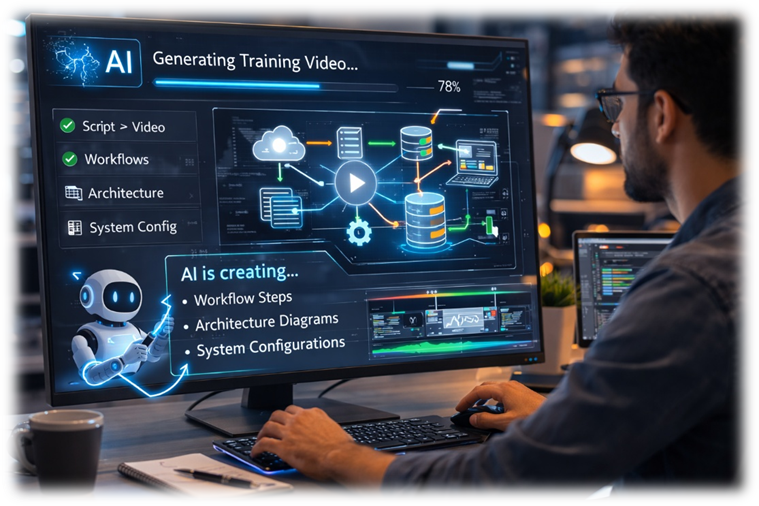
Interactive Video-Based Learning
AI tools can assist in creating technical training videos that explain complex systems clearly. These videos can demonstrate workflows, architecture diagrams, and system configurations.
Continuous Learning Support
Because IT systems change frequently, AI can help training teams update learning content quickly when platforms or tools evolve.
What Problems Does This Solve?
AI-driven training development helps IT organizations overcome several challenges:
- Slow updates when technologies change
- Limited availability of technical experts to create training content
- Lack of hands-on practice opportunities
With AI support, training teams can deliver updated technical learning programs more frequently.
Why Human Oversight Is Still Essential
Although AI tools provide many advantages, they cannot replace human expertise.
Technical training often includes safety procedures, compliance rules, and system instructions that must be completely accurate. AI-generated content may contain mistakes or misunderstand complex processes.
Because of this, instructional designers and subject matter experts must always review and refine AI-generated materials.
Human oversight ensures that training content:
- Reflects real operational practices
- Meets regulatory requirements
- Maintains instructional quality
- Supports effective learning experiences
The most successful organizations treat AI as a content creation assistant, not a replacement for learning professionals.
The Future of Technical Training Programs
AI is changing how technical training programs are developed, but it is not changing the core purpose of training.
The goal remains the same: helping employees gain the skills they need to perform their jobs safely and effectively.
What AI is changing is the speed and scale of course development.
With AI support, organizations can:
- Update learning materials faster
- Create more interactive training experiences
- Scale learning across multiple locations
- Reduce development bottlenecks
At the same time, human expertise remains essential for maintaining quality and accuracy.
The future of technical training programs will combine AI-powered course development with expert validation.
Organizations that adopt this balanced approach will be able to scale training more effectively while maintaining high standards of learning.
Conclusion
Artificial Intelligence is becoming an important tool in modern technical training programs. It helps training teams accelerate course development, create realistic learning scenarios, and deliver scalable digital learning across industries.
Manufacturing, healthcare, finance, and IT organizations are already using AI to improve training design and update learning content faster.
However, AI works best when combined with human expertise. Instructional designers and subject matter experts must guide and validate AI-generated materials to ensure accuracy and effectiveness.
When used strategically, AI strengthens technical training programs rather than replacing them. It allows organizations to build smarter, faster, and more adaptable learning ecosystems that support continuous skill development across the workforce.
Technical training plays a critical role in modern organizations. It helps employees move beyond theoretical knowledge and apply skills in real work situations. Whether someone is operating machinery in a factory, managing financial systems, working in a laboratory, or writing software code, technical training ensures they can perform tasks safely and correctly.
Traditional technical training often relied on long presentations, manuals, and static courses. While these methods provided information, they did not always help learners practice real-world decision-making. In industries where mistakes can lead to safety risks, financial loss, or system failure, training must go further than simply delivering information.
Today, Artificial Intelligence (AI) is helping organizations improve how technical training programs are designed and delivered. AI does not replace instructional designers or subject matter experts. Instead, it helps speed up course creation, generate learning scenarios, and support scalable digital learning programs.
Across industries such as manufacturing, healthcare, finance, and IT, AI is becoming a powerful tool that helps training teams build better learning experiences faster.
This article explains how AI is improving technical training programs and why human oversight remains essential to ensure accuracy, quality, and effectiveness.
Understanding Technical Training in Modern Organizations
Technical training focuses on teaching employees how to perform specialized tasks within their roles. These tasks may include operating equipment, following safety procedures, using complex software systems, or maintaining critical infrastructure.
Unlike general learning programs, technical training requires practical understanding. Employees must be able to apply what they learn in real situations.
For example:
- Factory workers must operate machines safely and identify equipment problems.
- Healthcare professionals must follow precise lab procedures and use medical equipment correctly.
- Financial analysts must navigate complex systems that monitor transactions.
- Software engineers must understand coding frameworks and cloud platforms.
In large organizations with multiple locations, keeping this training accurate and updated is challenging. Processes change, tools evolve, and regulations are frequently updated. Training teams must constantly revise learning materials.
This is where AI tools can make a significant difference.
AI helps training teams create and update learning content faster while maintaining consistency across large organizations.
Where AI Fits in Technical Training Development
AI works best as a support tool during the course development process. It helps generate first drafts of training content that instructional designers can refine.
Instead of starting from scratch, training teams can use AI to:
- Generate course outlines
- Convert documents into learning modules
- Create assessments and scenario-based exercises
- Draft scripts for training videos
- Produce visual job aids and diagrams
However, AI-generated content must always be reviewed by instructional designers and subject matter experts. Technical training often involves safety procedures, compliance rules, or system instructions. These details must be accurate.
Because of this, the most effective approach is AI-assisted training development with human validation.
AI speeds up content creation, while experts ensure that the information is correct and aligned with organizational standards.
AI in Manufacturing Technical Training
Manufacturing organizations rely heavily on technical training. Workers must understand how to operate equipment, perform maintenance tasks, and follow safety procedures.
Training often includes instructions for troubleshooting machines, identifying faults, and responding to emergencies.
AI is helping manufacturing companies improve training programs in several ways.
Safety Scenario Generation
AI can generate realistic workplace scenarios based on common safety incidents. These scenarios allow employees to practice decision-making before entering real work environments.
Instead of reading safety rules in slides, learners can interact with simulated situations and choose how to respond.
Visual Job Aid Creation
Manufacturing tasks often involve complex processes. AI tools can help create visual guides such as:
- Process maps
- Annotated diagrams
- Step-by-step instructions
These visual materials make it easier for workers to understand procedures.
Multilingual Learning Modules
Large manufacturing companies often operate across different countries. AI-powered translation tools help training teams create learning modules in multiple languages quickly.
This ensures that workers across locations receive consistent training.
What Problems Does This Solve?
AI helps reduce several challenges in manufacturing training:
- Slow updates when equipment changes
- Difficulty scaling training across multiple plants
- Overuse of text-heavy training slides
With AI support, training teams can update learning materials faster while keeping workers informed and prepared.
AI in Pharma and Healthcare Training
Technical training in healthcare and pharmaceutical organizations must meet strict regulatory standards. Employees must follow precise procedures when handling equipment, running tests, or managing clinical systems.
Training programs must also be updated regularly to match new regulations and inspection requirements.
AI is helping training teams develop more practical and scalable learning programs.
Converting Procedures into Learning Modules
Many healthcare processes are documented in detailed procedure manuals. AI tools can analyze these documents and convert them into structured learning modules.
This includes generating:
- Learning objectives
- Step-by-step training instructions
- Knowledge checks and assessments
Scenario-Based Learning
Healthcare professionals must make decisions in complex environments. AI can generate realistic scenarios that simulate hospital or laboratory situations.
These scenarios help learners practice applying procedures instead of only reading instructions.
Practice-Based Assessments
AI can help design assessments that test real-world skills, such as:
- Equipment handling procedures
- Laboratory workflow steps
- Clinical system operations
These assessments help learners build confidence before performing tasks in real environments.
What Problems Does This Solve?
AI-supported training helps healthcare organizations address common challenges:
- Delays in updating training materials
- Inconsistent training across hospitals or labs
- Overuse of theory-heavy learning content
By enabling faster course development, AI helps training teams maintain high standards while supporting large teams.
AI in Finance, Fintech, and BFSI Training
Financial institutions in the Banking, Financial Services, and Insurance (BFSI) sector rely on complex systems to manage transactions, monitor risks, and investigate suspicious activity. Employees must understand how to use these systems accurately and efficiently.
Technical training in finance and BFSI focuses on system workflows and operational procedures.
AI tools are helping training teams build more flexible learning programs.
System Simulation Development
AI can help create scripts for system walkthroughs and interactive simulations. These simulations show learners how to navigate digital platforms step by step.
Instead of reading instructions, learners can explore simulated systems and practice tasks.
Role-Based Learning
Employees in finance, fintech, and BFSI organizations perform highly specialized roles, with compliance and regulatory requirements playing a critical role. AI can help adapt training content for different roles without requiring a complete course redesign.
For example:
- Compliance teams may need training on regulatory requirements, AML processes, KYC verification, and fraud monitoring workflows
- Risk management teams may require training on risk assessment systems and reporting procedures
- Operations teams may need training on transaction processing, exception handling, and reconciliation workflows
- Customer-facing teams may require training on secure data handling and customer verification procedures
AI can help tailor training modules for these different needs while maintaining role-specific learning paths.
However, the BFSI sector operates under strict regulatory and data privacy requirements. Due to the confidential nature of financial data, organizations often implement guardrails when using AI. Leaders may be cautious about AI adoption because of concerns around data security, compliance, and regulatory risks.
As a result, AI in BFSI training is typically used within secure environments, controlled data inputs, and with human oversight to ensure compliance, accuracy, and confidentiality.
What Problems Does This Solve?
AI reduces several bottlenecks in financial training programs:
- Repetitive learning modules across departments
- Slow development of new training scenarios
- Complex content updates when systems change
With AI support, training teams can develop role-specific learning experiences more efficiently.
AI in IT and Software Training
The technology industry evolves rapidly. New tools, frameworks, and platforms appear constantly. Because of this, technical training programs must be updated frequently.
AI is particularly useful in IT training environments where practical exercises are essential.
Coding Challenges and Technical Scenarios
AI can generate coding problems, debugging exercises, and system failure scenarios. These activities help developers practice solving real technical issues.
Interactive Video-Based Learning
AI tools can assist in creating technical training videos that explain complex systems clearly. These videos can demonstrate workflows, architecture diagrams, and system configurations.
Continuous Learning Support
Because IT systems change frequently, AI can help training teams update learning content quickly when platforms or tools evolve.
What Problems Does This Solve?
AI-driven training development helps IT organizations overcome several challenges:
- Slow updates when technologies change
- Limited availability of technical experts to create training content
- Lack of hands-on practice opportunities
With AI support, training teams can deliver updated technical learning programs more frequently.
Why Human Oversight Is Still Essential
Although AI tools provide many advantages, they cannot replace human expertise.
Technical training often includes safety procedures, compliance rules, and system instructions that must be completely accurate. AI-generated content may contain mistakes or misunderstand complex processes.
Because of this, instructional designers and subject matter experts must always review and refine AI-generated materials.
Human oversight ensures that training content:
- Reflects real operational practices
- Meets regulatory requirements
- Maintains instructional quality
- Supports effective learning experiences
The most successful organizations treat AI as a content creation assistant, not a replacement for learning professionals.
The Future of Technical Training Programs
AI is changing how technical training programs are developed, but it is not changing the core purpose of training.
The goal remains the same: helping employees gain the skills they need to perform their jobs safely and effectively.
What AI is changing is the speed and scale of course development.
With AI support, organizations can:
- Update learning materials faster
- Create more interactive training experiences
- Scale learning across multiple locations
- Reduce development bottlenecks
At the same time, human expertise remains essential for maintaining quality and accuracy.
The future of technical training programs will combine AI-powered course development with expert validation.
Organizations that adopt this balanced approach will be able to scale training more effectively while maintaining high standards of learning.
Conclusion
Artificial Intelligence is becoming an important tool in modern technical training programs. It helps training teams accelerate course development, create realistic learning scenarios, and deliver scalable digital learning across industries.
Manufacturing, healthcare, finance, and IT organizations are already using AI to improve training design and update learning content faster.
However, AI works best when combined with human expertise. Instructional designers and subject matter experts must guide and validate AI-generated materials to ensure accuracy and effectiveness.
When used strategically, AI strengthens technical training programs rather than replacing them. It allows organizations to build smarter, faster, and more adaptable learning ecosystems that support continuous skill development across the workforce.
You must be logged in to post a comment.

- Most Recent
- Most Relevant


