


 Notification


 Staff
44 posts
Staff
44 posts



View from a rental car’s driver’s seat on a gravel road in the Utah red-rock desert, storm clouds building, a weathered ‘Impassable When Wet’ sign on the left, and a dashboard phone confidently showing a blue route line labeled ‘Faster route: saves 40 min’
On partner education, the factory we inherited, and the open air on the other side
When I was a kid, I got the front seat. Not because I was the oldest, but because of all my siblings I was the one most likely to read the map correctly. The big road atlas with its spine cracked at the pages we used most. The fold-out gas station maps that never, ever folded back the way they came. I took the job seriously. I could run a thumb down the thin blue line of a state highway and call the next turn a full mile before my father needed it.
A few years ago I drove the Golden Circle in the American Southwest. Zion, Bryce, Capitol Reef, Arches, Monument Valley, the long swing down to the Grand Canyon. If you’ve never done it, it’s one of those trips that quietly rearranges you; the scale of the place resets something. And this time, of course, I didn’t need an atlas. The map on my phone knew every road, every turnoff, every gas pump, to the meter.
Somewhere east of Capitol Reef, it offered me a shortcut. Forty minutes saved, down a county road that looked on the screen exactly like every other road. The pavement ended about a mile in. The gravel went to washboard. Clouds were stacking up over the mountains to the west, and a small sign, pocked with what I sincerely hope was hail damage, said Impassable When Wet.

Dash mounted phone, sulking and recalculating.
The map wasn’t wrong. The road was right there. What the map didn’t know was that I was in a rental sedan with about six inches of clearance, that it had been raining upstream for an hour, and that in that country a dry wash can turn into a river faster than you can turn a car around. The kid in the front seat knew, though. Not from the map. From a lifetime of noticing the things maps leave out.
I turned around. The phone sulked, and recalculated.
I’ve thought about that road a lot this year, because it’s the most honest picture I have of where partner education stands. For a generation, we taught people to read the map. The map is perfect now, and it’s in everyone’s pocket. What’s left to teach is the thing that turned me around on that gravel — the judgment to notice when the map and the terrain disagree. We’ve always had words for it: horse sense, a feel for the work, plain common sense. We’ve just never had a system for teaching it. Partner programs are where that gap is about to get expensive.
The factory we inherited
For about twenty years, partner education has mostly been cartography.
A portal. A login. A catalog sorted by product line. A certification exam at the end of the path. A pricing guide, updated quarterly, stale by week two. Behind it, a durable machine: author a course, package it, launch it, record the completion and the score. Next.
Squint a little and you can hear the shift whistle. That’s no coincidence, either — the factory has been in the blueprints of education for over a century.
In 1916, two books about education came out within months of each other. One was Ellwood Cubberley’s Public School Administration, which said plainly what the new American school system was for: “Our schools are, in a sense, factories in which the raw products (children) are to be shaped and fashioned into products to meet the various demands of life.” The other was John Dewey’s Democracy and Education, which argued the opposite: “Give the pupils something to do, not something to learn; and the doing is of such a nature as to demand thinking; learning naturally results.”
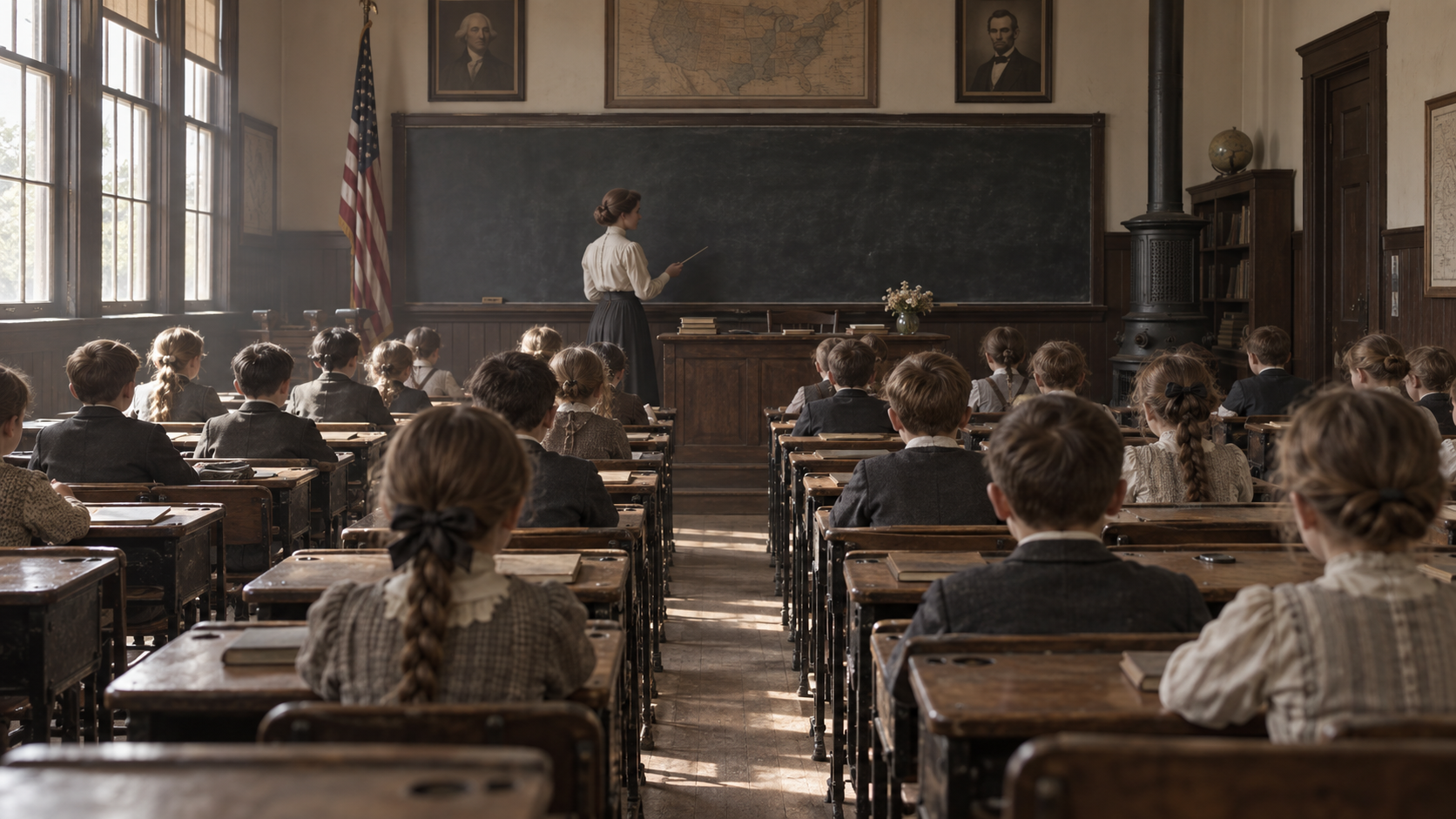
We built Cubberley’s school. Then, a century later, we built Cubberley’s training architecture.
I want to be fair to the factory, because it earned its place. It scaled. It was predictable. It gave a learner in Jakarta the same course as a learner in Ohio. It made compliance defensible and costs forecastable. The package-and-record standard behind modern e-learning is one of the quiet infrastructure wins of the enterprise era, and a great deal of what works today stands on it.
But a factory does particular things to learning, and pretending otherwise does nobody any favors. These restrictions came standard, like the fins on a ’59 Cadillac — part of the design, whether or not anyone ordered them.
- It batches. Everyone moves through the same line at the same pace, regardless of what they already know or what they’ll actually face.
- It standardizes the output. There’s one right answer, and it’s on the key. Variation is a defect to be removed, not a signal to be studied.
- It isolates the worker. Self-paced means alone. The learner never argues a call out loud, never hears how a peer reasoned through the same problem.
- It measures throughput. Completion, score, seat time — the factory counts units off the line, not whether the units work in the field.
- It has no line item for curiosity. A question that wanders off the path is inefficiency. Wonder doesn’t fit on the conveyor.
Paulo Freire had a name for this in 1968: the banking model, in which knowledge is deposited into a learner like coins into an account. It’s a precise description of every partner portal I’ve ever seen. We make the deposit. We print the receipt. We call the receipt a certification.
We never trained for judgment. We trained for the receipt, because the receipt was what the factory could print.
Why you should care
Because the receipt doesn’t sell anything.
Something close to half of B2B revenue now arrives through partners. Half. Somewhere a CFO just set down their coffee. And the partners carrying it aren’t failing for lack of information — they’ve had the portal, the catalog, and the certification for years. They’re failing out in the real world, in front of real customers, at the moments the manual didn’t anticipate. The buyer who says yes but means not this quarter. The integration that breaks in a way the documentation never described. The feature on the datasheet that matters enormously to this customer and not at all to the last one.
CRN’s 2025 partner research found that roughly seventy percent of partners stopped selling, or left entirely, within twelve months — without ever formally leaving. No farewell email, no exit interview — just a slow fade, like a houseguest who drifts out the back door during dessert, and you only notice when the dashboard goes gray. Meanwhile the old eighty-twenty rule holds stubbornly: a fifth of your partners carry most of the revenue. PartnerStack has reported certified partners generating up to six times the revenue of uncertified ones — which tells you certification can matter enormously, and raises the obvious question of what the effective programs are certifying.
And partners are a different animal from your own employees. You can’t mandate anything; they don’t report to you. Every quarter, they decide whether your product is worth their attention, and when your enablement doesn’t help them win, they don’t complain — they just sell something else. Inside your own walls, completion can masquerade as capability for years. Out here, the market grades the work.
That’s why partner education is the proving ground. If a better model of learning is going to earn its keep anywhere, it has to earn it where nobody can be compelled to pretend. And whatever gets proven out here won’t stay out here. Every organization has a workforce inside its own walls facing the same shift, and the wise ones will keep an eye on what works out on the frontier before they commit to it at home. (Whether they actually will is another matter. Organizations are not famous for reading the reports from their own scouts.)
A hundred years of being right
I spent a good part of my early career in theater, and nobody in a theater would ever try to learn a play by reading the script alone and taking a quiz on it. You rehearse. You get it wrong on your feet, in front of people. The director gives notes. Your scene partner does something unexpected on a Tuesday and you have to find your way through it, and that night you understand the character a little better than you did on Monday. Rehearsal is guided practice in a group, with judgment on the line every single time — and the theater has been doing it that way since before anyone had a word for “curriculum.”
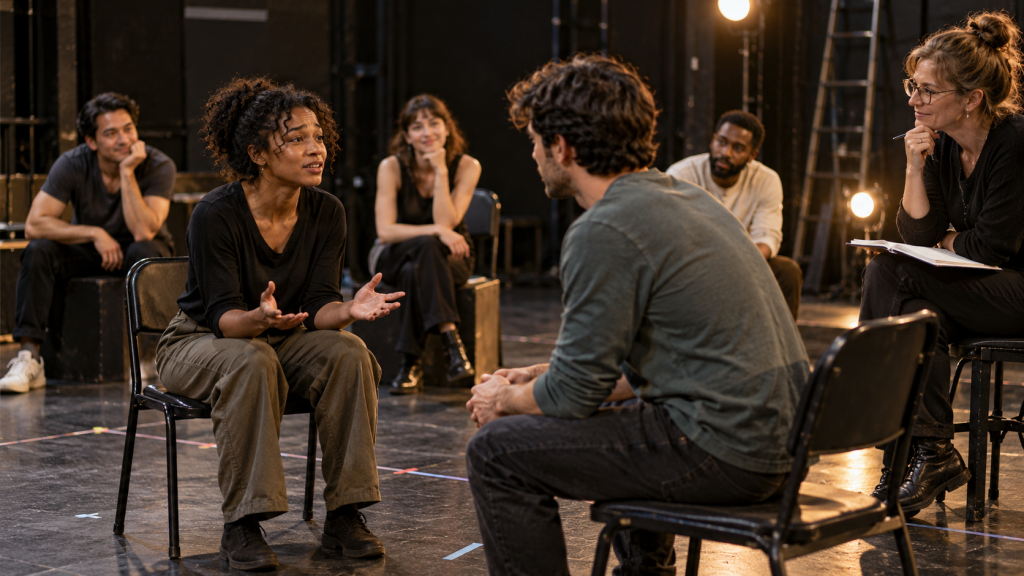
Guided practice in a group, with judgment on the line every time. Nobody learns a play from the script alone.
Education research has been saying much the same thing, patiently and at great length, for most of the last hundred years. Dewey made the case for learning by doing in 1916 and again in 1938. Vygotsky showed that we learn in the company of others, stretched just past what we can do alone. Donald Schön described the reflective practitioner — the professional who gets better by examining their own calls. David Kolb built a whole model of learning on the cycle of experience, reflection, and trying again. Seymour Papert argued that people learn best by building things they care about. Jean Lave and Etienne Wenger showed that expertise lives in communities of practice, passed person to person at the edges of real work. Larry Michaelsen developed team-based learning in the late 1970s and watched small groups outperform lecture halls. Manu Kapur demonstrated that students who struggle with a problem before being taught the solution learn it more deeply than those handed the answer first.
That’s a century of very smart people, from very different corners of the field, all pointing the same direction like weathervanes in a steady wind: toward practice, toward each other, toward reflection, toward a little productive struggle.
So why did the factory win anyway?
Economics. Every one of those models needs a guide — someone to build the scenario, run the practice, read the room, adjudicate the call, ask the next good question. A guide doesn’t scale like a conveyor belt. You can put ten thousand partners through a self-paced course for roughly the cost of one. You cannot put ten thousand partners through guided practice for anything close to that.
The researchers had the better argument. The accountants had the better spreadsheet. We all know who wins that meeting.
The door opens
The math just changed, and from two directions at once.
The thing that changed it is AI. I’ve held off saying so until now, on purpose, because I think the technology is honestly the least interesting character in this story. It’s the stagehand who finally got the fire door unstuck. Important! Deserves a round of applause. But the show is what’s out there on the other side.
First, the answers went free. Any partner can now ask an AI assistant any question about your product and get an answer instantly, in their own language, at eleven o’clock the night before the customer call. That was the factory’s entire reason for existing — delivering information that was scarce — and it’s gone. The map is in everyone’s pocket. A better map isn’t an advantage anymore, for you or for your competitors.
Second, the cost of building practice collapsed. The same generative AI that made answers free makes it possible to build scenarios, role-plays, branching cases, and team exercises at a pace and variety no design team could touch. I watch this happen in our own shop with Coco, the new Content Composer in Adobe Learning Manager, which drafts courses, practice, and assessments from the materials a team already has — the product docs, the recorded webinars, the slide decks gathering dust in a shared drive. The expensive part of the guide — the part that kept Dewey on the shelf for a century — just got cheap.
So the interesting question for partner programs has quietly changed. We’ve spent twenty years asking how to deliver content faster. Now we get to ask a much more fun one: what does a good guide actually do, now that we can finally afford one?
(And no, the answer is not to trade in the learning platform for a lot more meetings. Nobody guides ten thousand partners by clearing their calendar. At that scale the guide is a platform, asked to do things the factory never asked of it — generate the practice, host the rehearsal, keep the logbook — with people placed precisely where their judgment matters most.)
I’ve been chewing on that all year, in sessions and hallways and more than one late-night whiteboard, and four things keep coming back.
A guide makes you practice before it counts. Not a quiz on the datasheet — a situation. A customer who pushes back. A deal that stalls in an unfamiliar way. And not one situation but many variations on the same underlying problem, until the pattern belongs to you. Pilots and surgeons have trained this way for decades. Run one scenario and you’ll recognize that scenario the next time it walks in the door. Run a hundred variations and you start to recognize the shape of the trouble, whatever outfit it’s wearing that day. This is where something like the Virtual Coach in Adobe Learning Manager earns its keep: a partner can rehearse the difficult customer conversation against a counterpart that pushes back, as many times as it takes, before trying it on someone who can actually say no to a purchase order.
A guide makes you commit before the reveal. The single most valuable moment in practice is right before the outcome, when you have to decide, and say why. The gap between what you expected and what actually happened is where learning lives. Hand someone the answer first and you close the gap before they ever reach it.
A guide walks with a group. This is the rehearsal room again. Team-based learning has a value individual coursework can’t reproduce: reasoning argued out loud, calls defended in front of peers, instincts passing from person to person the way they always have in any good shop, kitchen, or crew. Half the learning is in the arguing. And a partner organization is already a team — it seems a little silly to keep training them one at a time, in separate rooms, with the lights off. It’s a big part of why I’m so taken with LiveHub, Adobe’s new home for live, synchronous learning: the rehearsal room, rebuilt for a cast scattered across six time zones.
A guide keeps a record of how you decided, not just what you finished. A completion record says a partner sat through something. It can’t tell you whether their judgment is sharpening, or where it breaks. The record worth keeping looks more like a pilot’s logbook than a transcript: calls made, reasons given, outcomes observed. Nobody ever went back to reread an old checkmark to get better at their job. A logbook, on the other hand, gets more useful every year you keep it.
The Shift, in One Line
From measuring what partners consumed to measuring what changed afterward — in how they decide, how they deliver, and eventually what they sell.
No, I don’t think that means abandon everything or leap to conclusions
Now, before anyone runs off to buy a scenario generator, one caveat worth taking seriously.
The tools can generate a hundred scenarios by lunch, and a few of them will be subtly, confidently wrong. The defense is a person with enough real-world judgment to catch it. (Yes — the very skill we’re trying to build in the partners. The universe has a sense of humor.) The better tools in this territory are being designed around that fact rather than pretending it away. Coco, for instance, keeps the designer firmly in the editor’s chair — shaping, correcting, and approving what it drafts, never just rubber-stamping it.
That asks something genuinely hard of the people who design learning. They have to let the machine do the part it’s good at, and own — fully, visibly — the part it isn’t. The designer stops being the author of every word and becomes the one who decides what’s true, what’s useful, and what ships. I’d call that a promotion. I’m not sure everyone will feel it that way at first, and it takes people who can set their ego down long enough to use both halves of the partnership.
Getting that partnership right — tools that make human judgment feel like the valuable part of the work instead of the overhead — is where I think the most interesting product work in our field is happening right now. It asks for a real shift in how we think about building learning, the kind that makes people a little uncomfortable in meetings. In my experience, that discomfort is usually a sign you’re onto something.
Into the open air
I didn’t learn to turn around on that gravel road from a map. Nobody learns horse sense on a conveyor belt. It gets earned the way Dewey said it would be — by doing something that demanded thinking, alongside people who were a little further down the road, and getting it wrong often enough to learn what right feels like.
For a hundred years, we couldn’t afford to teach that way at scale, so we built the factory instead, and told ourselves the receipt was the same thing as the skill. The factory’s reason for existing just evaporated. The map is free. What’s left is the country — the real one, with customers and consequences and problems nobody wrote down.

There’s a much older version of this idea, and I can’t resist it.
In the autumn of 44 BC, with the Roman Republic coming apart around him, Marcus Tullius Cicero sat down to write a long letter to his son. Young Marcus was in Athens, officially studying philosophy and, by most accounts, studying the local wine with considerably more dedication. His father had about a year to live, and may well have suspected it. Rome’s most famous lawyer — a man who could have drafted the most airtight rulebook in the ancient world — didn’t send one. He sent De Officiis, usually translated On Duties: a patient, rambling, very human walk through how a decent person decides what to do when the right answer isn’t written down anywhere. The first virtue on his list is practical wisdom, which is really just horse sense in a toga.
The line everyone remembers comes early. Cicero borrows it from Plato: non nobis solum nati sumus — we are not born for ourselves alone. In Walter Miller’s classic translation, it runs on like this:
…we are not born for ourselves alone, but our country claims a share of our being, and our friends a share… we ought to follow Nature as our guide, to contribute to the general good by an interchange of acts of kindness, by giving and receiving, and thus by our skill, our industry, and our talents to cement human society more closely together, man to man.
Follow Nature as our guide. By giving and receiving. Two thousand years before anyone coined “team-based learning,” there it is — the guide, the exchange, the skill passed hand to hand. And later in the same book Cicero pushes it further: knowledge that stays locked up in contemplation, never turned outward to help anyone, is lame and incomplete. Even the wisest person, he says, would put down their books to answer a neighbor’s need.
That’s the part the factory let us forget. Somewhere along the line, passing on what we know stopped being an obligation and became a deposit — something you schedule, package, and track to completion. But every seasoned channel manager, every sales engineer with twenty years of scar tissue, every designer who can smell a bad scenario from across the room, is carrying horse sense that somebody newer desperately needs. Walking with them was never a program feature. It’s a duty, in exactly Cicero’s sense of the word.
And here’s the kicker. That letter, written for one young man with a wine habit, outlived the Republic, the Empire, and the language it was written in. It was one of the very first classical works to come off the new printing presses in the 1460s, and it has been guiding readers ever since. Not a map. A father, walking with his son, two thousand years down the road.
Some people find all of this frightening. I’ll confess I find it about as exciting as anything that’s happened in this field in my career. It’s a chance to walk out of the grind and into the open air, where curiosity is an asset again instead of an inefficiency, and a question that wanders off the path might be the best thing that happened all day.
Stop handing out maps. Everyone has one now.
Walk with them.
This is the first piece in a series on what comes after the factory model of enterprise learning — starting with partners, where the change shows up first, and working inward.
View from a rental car’s driver’s seat on a gravel road in the Utah red-rock desert, storm clouds building, a weathered ‘Impassable When Wet’ sign on the left, and a dashboard phone confidently showing a blue route line labeled ‘Faster route: saves 40 min’
On partner education, the factory we inherited, and the open air on the other side
When I was a kid, I got the front seat. Not because I was the oldest, but because of all my siblings I was the one most likely to read the map correctly. The big road atlas with its spine cracked at the pages we used most. The fold-out gas station maps that never, ever folded back the way they came. I took the job seriously. I could run a thumb down the thin blue line of a state highway and call the next turn a full mile before my father needed it.
A few years ago I drove the Golden Circle in the American Southwest. Zion, Bryce, Capitol Reef, Arches, Monument Valley, the long swing down to the Grand Canyon. If you’ve never done it, it’s one of those trips that quietly rearranges you; the scale of the place resets something. And this time, of course, I didn’t need an atlas. The map on my phone knew every road, every turnoff, every gas pump, to the meter.
Somewhere east of Capitol Reef, it offered me a shortcut. Forty minutes saved, down a county road that looked on the screen exactly like every other road. The pavement ended about a mile in. The gravel went to washboard. Clouds were stacking up over the mountains to the west, and a small sign, pocked with what I sincerely hope was hail damage, said Impassable When Wet.
Dash mounted phone, sulking and recalculating.
The map wasn’t wrong. The road was right there. What the map didn’t know was that I was in a rental sedan with about six inches of clearance, that it had been raining upstream for an hour, and that in that country a dry wash can turn into a river faster than you can turn a car around. The kid in the front seat knew, though. Not from the map. From a lifetime of noticing the things maps leave out.
I turned around. The phone sulked, and recalculated.
I’ve thought about that road a lot this year, because it’s the most honest picture I have of where partner education stands. For a generation, we taught people to read the map. The map is perfect now, and it’s in everyone’s pocket. What’s left to teach is the thing that turned me around on that gravel — the judgment to notice when the map and the terrain disagree. We’ve always had words for it: horse sense, a feel for the work, plain common sense. We’ve just never had a system for teaching it. Partner programs are where that gap is about to get expensive.
The factory we inherited
For about twenty years, partner education has mostly been cartography.
A portal. A login. A catalog sorted by product line. A certification exam at the end of the path. A pricing guide, updated quarterly, stale by week two. Behind it, a durable machine: author a course, package it, launch it, record the completion and the score. Next.
Squint a little and you can hear the shift whistle. That’s no coincidence, either — the factory has been in the blueprints of education for over a century.
In 1916, two books about education came out within months of each other. One was Ellwood Cubberley’s Public School Administration, which said plainly what the new American school system was for: “Our schools are, in a sense, factories in which the raw products (children) are to be shaped and fashioned into products to meet the various demands of life.” The other was John Dewey’s Democracy and Education, which argued the opposite: “Give the pupils something to do, not something to learn; and the doing is of such a nature as to demand thinking; learning naturally results.”
We built Cubberley’s school. Then, a century later, we built Cubberley’s training architecture.
I want to be fair to the factory, because it earned its place. It scaled. It was predictable. It gave a learner in Jakarta the same course as a learner in Ohio. It made compliance defensible and costs forecastable. The package-and-record standard behind modern e-learning is one of the quiet infrastructure wins of the enterprise era, and a great deal of what works today stands on it.
But a factory does particular things to learning, and pretending otherwise does nobody any favors. These restrictions came standard, like the fins on a ’59 Cadillac — part of the design, whether or not anyone ordered them.
- It batches. Everyone moves through the same line at the same pace, regardless of what they already know or what they’ll actually face.
- It standardizes the output. There’s one right answer, and it’s on the key. Variation is a defect to be removed, not a signal to be studied.
- It isolates the worker. Self-paced means alone. The learner never argues a call out loud, never hears how a peer reasoned through the same problem.
- It measures throughput. Completion, score, seat time — the factory counts units off the line, not whether the units work in the field.
- It has no line item for curiosity. A question that wanders off the path is inefficiency. Wonder doesn’t fit on the conveyor.
Paulo Freire had a name for this in 1968: the banking model, in which knowledge is deposited into a learner like coins into an account. It’s a precise description of every partner portal I’ve ever seen. We make the deposit. We print the receipt. We call the receipt a certification.
We never trained for judgment. We trained for the receipt, because the receipt was what the factory could print.
Why you should care
Because the receipt doesn’t sell anything.
Something close to half of B2B revenue now arrives through partners. Half. Somewhere a CFO just set down their coffee. And the partners carrying it aren’t failing for lack of information — they’ve had the portal, the catalog, and the certification for years. They’re failing out in the real world, in front of real customers, at the moments the manual didn’t anticipate. The buyer who says yes but means not this quarter. The integration that breaks in a way the documentation never described. The feature on the datasheet that matters enormously to this customer and not at all to the last one.
CRN’s 2025 partner research found that roughly seventy percent of partners stopped selling, or left entirely, within twelve months — without ever formally leaving. No farewell email, no exit interview — just a slow fade, like a houseguest who drifts out the back door during dessert, and you only notice when the dashboard goes gray. Meanwhile the old eighty-twenty rule holds stubbornly: a fifth of your partners carry most of the revenue. PartnerStack has reported certified partners generating up to six times the revenue of uncertified ones — which tells you certification can matter enormously, and raises the obvious question of what the effective programs are certifying.
And partners are a different animal from your own employees. You can’t mandate anything; they don’t report to you. Every quarter, they decide whether your product is worth their attention, and when your enablement doesn’t help them win, they don’t complain — they just sell something else. Inside your own walls, completion can masquerade as capability for years. Out here, the market grades the work.
That’s why partner education is the proving ground. If a better model of learning is going to earn its keep anywhere, it has to earn it where nobody can be compelled to pretend. And whatever gets proven out here won’t stay out here. Every organization has a workforce inside its own walls facing the same shift, and the wise ones will keep an eye on what works out on the frontier before they commit to it at home. (Whether they actually will is another matter. Organizations are not famous for reading the reports from their own scouts.)
A hundred years of being right
I spent a good part of my early career in theater, and nobody in a theater would ever try to learn a play by reading the script alone and taking a quiz on it. You rehearse. You get it wrong on your feet, in front of people. The director gives notes. Your scene partner does something unexpected on a Tuesday and you have to find your way through it, and that night you understand the character a little better than you did on Monday. Rehearsal is guided practice in a group, with judgment on the line every single time — and the theater has been doing it that way since before anyone had a word for “curriculum.”
Guided practice in a group, with judgment on the line every time. Nobody learns a play from the script alone.
Education research has been saying much the same thing, patiently and at great length, for most of the last hundred years. Dewey made the case for learning by doing in 1916 and again in 1938. Vygotsky showed that we learn in the company of others, stretched just past what we can do alone. Donald Schön described the reflective practitioner — the professional who gets better by examining their own calls. David Kolb built a whole model of learning on the cycle of experience, reflection, and trying again. Seymour Papert argued that people learn best by building things they care about. Jean Lave and Etienne Wenger showed that expertise lives in communities of practice, passed person to person at the edges of real work. Larry Michaelsen developed team-based learning in the late 1970s and watched small groups outperform lecture halls. Manu Kapur demonstrated that students who struggle with a problem before being taught the solution learn it more deeply than those handed the answer first.
That’s a century of very smart people, from very different corners of the field, all pointing the same direction like weathervanes in a steady wind: toward practice, toward each other, toward reflection, toward a little productive struggle.
So why did the factory win anyway?
Economics. Every one of those models needs a guide — someone to build the scenario, run the practice, read the room, adjudicate the call, ask the next good question. A guide doesn’t scale like a conveyor belt. You can put ten thousand partners through a self-paced course for roughly the cost of one. You cannot put ten thousand partners through guided practice for anything close to that.
The researchers had the better argument. The accountants had the better spreadsheet. We all know who wins that meeting.
The door opens
The math just changed, and from two directions at once.
The thing that changed it is AI. I’ve held off saying so until now, on purpose, because I think the technology is honestly the least interesting character in this story. It’s the stagehand who finally got the fire door unstuck. Important! Deserves a round of applause. But the show is what’s out there on the other side.
First, the answers went free. Any partner can now ask an AI assistant any question about your product and get an answer instantly, in their own language, at eleven o’clock the night before the customer call. That was the factory’s entire reason for existing — delivering information that was scarce — and it’s gone. The map is in everyone’s pocket. A better map isn’t an advantage anymore, for you or for your competitors.
Second, the cost of building practice collapsed. The same generative AI that made answers free makes it possible to build scenarios, role-plays, branching cases, and team exercises at a pace and variety no design team could touch. I watch this happen in our own shop with Coco, the new Content Composer in Adobe Learning Manager, which drafts courses, practice, and assessments from the materials a team already has — the product docs, the recorded webinars, the slide decks gathering dust in a shared drive. The expensive part of the guide — the part that kept Dewey on the shelf for a century — just got cheap.
So the interesting question for partner programs has quietly changed. We’ve spent twenty years asking how to deliver content faster. Now we get to ask a much more fun one: what does a good guide actually do, now that we can finally afford one?
(And no, the answer is not to trade in the learning platform for a lot more meetings. Nobody guides ten thousand partners by clearing their calendar. At that scale the guide is a platform, asked to do things the factory never asked of it — generate the practice, host the rehearsal, keep the logbook — with people placed precisely where their judgment matters most.)
I’ve been chewing on that all year, in sessions and hallways and more than one late-night whiteboard, and four things keep coming back.
A guide makes you practice before it counts. Not a quiz on the datasheet — a situation. A customer who pushes back. A deal that stalls in an unfamiliar way. And not one situation but many variations on the same underlying problem, until the pattern belongs to you. Pilots and surgeons have trained this way for decades. Run one scenario and you’ll recognize that scenario the next time it walks in the door. Run a hundred variations and you start to recognize the shape of the trouble, whatever outfit it’s wearing that day. This is where something like the Virtual Coach in Adobe Learning Manager earns its keep: a partner can rehearse the difficult customer conversation against a counterpart that pushes back, as many times as it takes, before trying it on someone who can actually say no to a purchase order.
A guide makes you commit before the reveal. The single most valuable moment in practice is right before the outcome, when you have to decide, and say why. The gap between what you expected and what actually happened is where learning lives. Hand someone the answer first and you close the gap before they ever reach it.
A guide walks with a group. This is the rehearsal room again. Team-based learning has a value individual coursework can’t reproduce: reasoning argued out loud, calls defended in front of peers, instincts passing from person to person the way they always have in any good shop, kitchen, or crew. Half the learning is in the arguing. And a partner organization is already a team — it seems a little silly to keep training them one at a time, in separate rooms, with the lights off. It’s a big part of why I’m so taken with LiveHub, Adobe’s new home for live, synchronous learning: the rehearsal room, rebuilt for a cast scattered across six time zones.
A guide keeps a record of how you decided, not just what you finished. A completion record says a partner sat through something. It can’t tell you whether their judgment is sharpening, or where it breaks. The record worth keeping looks more like a pilot’s logbook than a transcript: calls made, reasons given, outcomes observed. Nobody ever went back to reread an old checkmark to get better at their job. A logbook, on the other hand, gets more useful every year you keep it.
The Shift, in One Line
From measuring what partners consumed to measuring what changed afterward — in how they decide, how they deliver, and eventually what they sell.
No, I don’t think that means abandon everything or leap to conclusions
Now, before anyone runs off to buy a scenario generator, one caveat worth taking seriously.
The tools can generate a hundred scenarios by lunch, and a few of them will be subtly, confidently wrong. The defense is a person with enough real-world judgment to catch it. (Yes — the very skill we’re trying to build in the partners. The universe has a sense of humor.) The better tools in this territory are being designed around that fact rather than pretending it away. Coco, for instance, keeps the designer firmly in the editor’s chair — shaping, correcting, and approving what it drafts, never just rubber-stamping it.
That asks something genuinely hard of the people who design learning. They have to let the machine do the part it’s good at, and own — fully, visibly — the part it isn’t. The designer stops being the author of every word and becomes the one who decides what’s true, what’s useful, and what ships. I’d call that a promotion. I’m not sure everyone will feel it that way at first, and it takes people who can set their ego down long enough to use both halves of the partnership.
Getting that partnership right — tools that make human judgment feel like the valuable part of the work instead of the overhead — is where I think the most interesting product work in our field is happening right now. It asks for a real shift in how we think about building learning, the kind that makes people a little uncomfortable in meetings. In my experience, that discomfort is usually a sign you’re onto something.
Into the open air
I didn’t learn to turn around on that gravel road from a map. Nobody learns horse sense on a conveyor belt. It gets earned the way Dewey said it would be — by doing something that demanded thinking, alongside people who were a little further down the road, and getting it wrong often enough to learn what right feels like.
For a hundred years, we couldn’t afford to teach that way at scale, so we built the factory instead, and told ourselves the receipt was the same thing as the skill. The factory’s reason for existing just evaporated. The map is free. What’s left is the country — the real one, with customers and consequences and problems nobody wrote down.
There’s a much older version of this idea, and I can’t resist it.
In the autumn of 44 BC, with the Roman Republic coming apart around him, Marcus Tullius Cicero sat down to write a long letter to his son. Young Marcus was in Athens, officially studying philosophy and, by most accounts, studying the local wine with considerably more dedication. His father had about a year to live, and may well have suspected it. Rome’s most famous lawyer — a man who could have drafted the most airtight rulebook in the ancient world — didn’t send one. He sent De Officiis, usually translated On Duties: a patient, rambling, very human walk through how a decent person decides what to do when the right answer isn’t written down anywhere. The first virtue on his list is practical wisdom, which is really just horse sense in a toga.
The line everyone remembers comes early. Cicero borrows it from Plato: non nobis solum nati sumus — we are not born for ourselves alone. In Walter Miller’s classic translation, it runs on like this:
…we are not born for ourselves alone, but our country claims a share of our being, and our friends a share… we ought to follow Nature as our guide, to contribute to the general good by an interchange of acts of kindness, by giving and receiving, and thus by our skill, our industry, and our talents to cement human society more closely together, man to man.
Follow Nature as our guide. By giving and receiving. Two thousand years before anyone coined “team-based learning,” there it is — the guide, the exchange, the skill passed hand to hand. And later in the same book Cicero pushes it further: knowledge that stays locked up in contemplation, never turned outward to help anyone, is lame and incomplete. Even the wisest person, he says, would put down their books to answer a neighbor’s need.
That’s the part the factory let us forget. Somewhere along the line, passing on what we know stopped being an obligation and became a deposit — something you schedule, package, and track to completion. But every seasoned channel manager, every sales engineer with twenty years of scar tissue, every designer who can smell a bad scenario from across the room, is carrying horse sense that somebody newer desperately needs. Walking with them was never a program feature. It’s a duty, in exactly Cicero’s sense of the word.
And here’s the kicker. That letter, written for one young man with a wine habit, outlived the Republic, the Empire, and the language it was written in. It was one of the very first classical works to come off the new printing presses in the 1460s, and it has been guiding readers ever since. Not a map. A father, walking with his son, two thousand years down the road.
Some people find all of this frightening. I’ll confess I find it about as exciting as anything that’s happened in this field in my career. It’s a chance to walk out of the grind and into the open air, where curiosity is an asset again instead of an inefficiency, and a question that wanders off the path might be the best thing that happened all day.
Stop handing out maps. Everyone has one now.
Walk with them.
This is the first piece in a series on what comes after the factory model of enterprise learning — starting with partners, where the change shows up first, and working inward.
You must be logged in to post a comment.

- Most Recent
- Most Relevant


